 Ben Carter5 min read
Modern engineering continuously pushes the boundaries of mechanical endurance, thermal resistance, and structural weight. As standard subtractive manufacturing reaches its limits, industrial leaders increasingly rely on powder-based fabrication to bypass traditional metallurgical constraints. Transforming fine microscopic particles into dense, high-integrity components represents one of the most substantial evolutions in physical metallurgy. By mastering thermal consolidation at atomic levels, manufacturers can produce geometry and alloy combinations that were once deemed technically impossible.
What makes powder metallurgy essential for next generation tech?
Traditional manufacturing relies heavily on melting, casting, and extensive computer numerical control machining. While these processes have sustained industrial production for over a century, they create substantial drawbacks when handling extreme-performance alloys. Casting often yields uneven grain boundaries, segregation, and structural voids that compromise component integrity under intense stress. In contrast, powder metallurgy operates from the ground up, granting engineers absolute command over raw material chemistry before consolidation even begins.
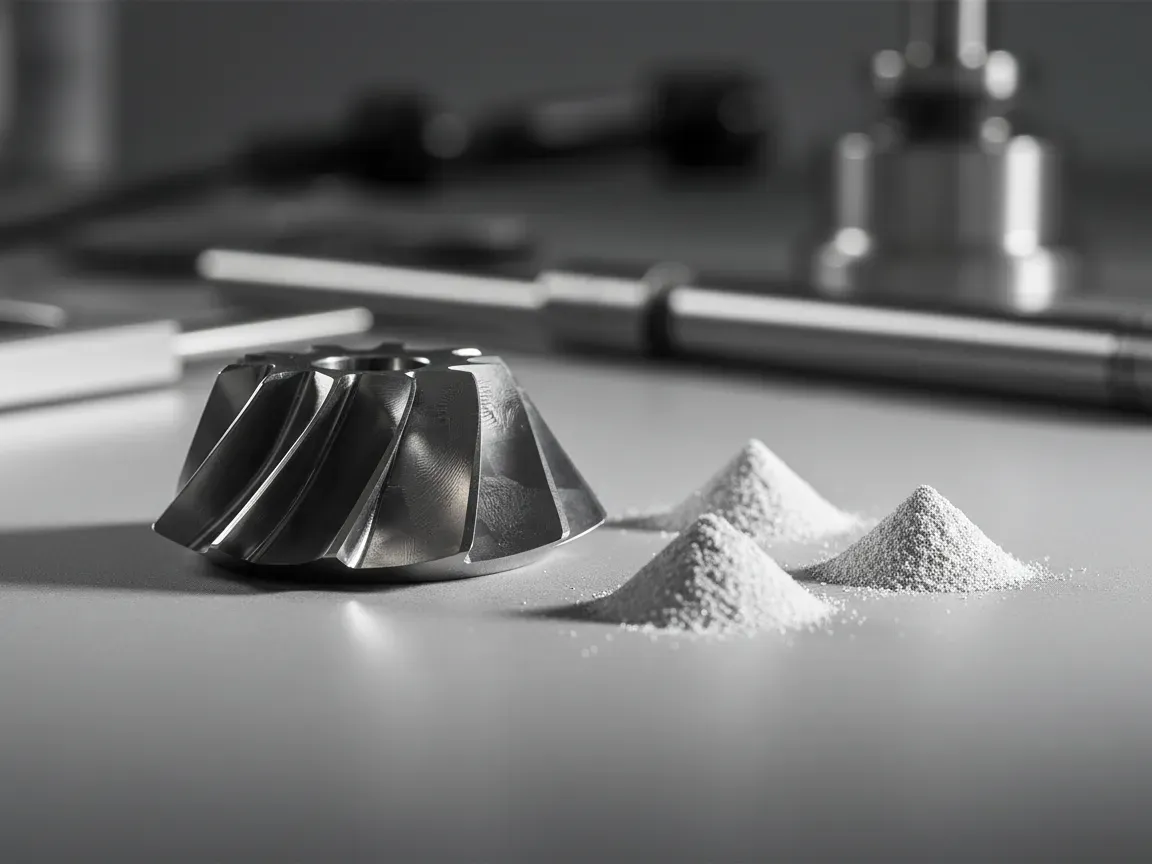
Raw material utilization represents a major competitive advantage. Traditional subtractive processes frequently turn up to eighty percent of an expensive titanium or nickel alloy ingot into scrap shavings. Powder consolidation achieves near-net-shape geometry directly from raw particulates, drastically minimizing secondary machining and scrap rates. This high material yield makes it financially viable to utilize exotic compounds, refractory metals, and ultra-hard ceramics in commercial production volumes.
Beyond economic efficiency, the control over microstructure is unmatched. In powder consolidation, every tiny particle can feature an identical chemical composition, ensuring consistent mechanical behavior across the entire component. This microstructural uniformity prevents thermal cracking, minimizes directional weakness, and yields dependable tensile strength in mission-critical applications.
How modern thermal consolidation alters component durability?
Consolidating metal or ceramic particles into solid mass requires precise thermal energy and pressure management. Historically, this meant placing compacted green parts into conventional radiant furnaces for dozens of hours. Such prolonged heating cycles promoted uncontrolled grain growth, which weakened the final piece and degraded surface hardness. Recent breakthroughs in field-assisted and pressure-assisted consolidation have transformed this dynamic entirely.
Cutting-edge sintering technology applies pulsed direct electrical currents alongside high uniaxial mechanical pressure to heat the material internally through Joule heating. Because energy transfers directly through the powder mass rather than relying on slow external conduction, heating rates skyrocket to hundreds of degrees per minute. This ultra-fast cycle minimizes the duration at elevated temperatures, effectively arresting grain boundary growth and preserving fine nanostructures.
Retaining fine grain structures directly enhances physical durability, improving both yield strength and fatigue resistance through the Hall-Petch relationship. Modern components consolidated via rapid electrical methods demonstrate near-theoretical density with virtually zero internal porosity. By eliminating micro-voids, parts withstand aggressive mechanical cycling, resist crack propagation, and survive corrosive environments far longer than traditionally cast counterparts.
Key industries adopting high precision material bonding
The ability to create fully dense, tailor-made materials has triggered rapid adoption across diverse technology sectors where failure is not an option.
- Aerospace and defense: Propulsion systems and thermal protection shields demand materials that survive extreme gradients. Powder-consolidated intermetallic compounds and refractory alloys provide high strength-to-weight ratios and creep resistance for turbine blades, rocket nozzles, and hypersonic guidance components.
- Automotive and electric mobility: Electric vehicles require efficient thermal management and lightweight structural members. Advanced sintering enables the high-volume production of specialized magnetic cores, planetary gear sets, and copper-graphite composites for electric drivetrains with minimal energy losses.
- Biomedical devices: Implantology relies on porous titanium and specialized bioceramics that mimic human bone stiffness to prevent stress shielding. Field-assisted sintering allows exact density gradients across a single implant, promoting cellular integration on the surface while maintaining rigid mechanical stability at the core.
- Semiconductor tooling and power electronics: Thermal spreaders made from diamond-copper composites dissipate massive heat loads from high-density microchips, preventing thermal throttling in high-performance computing centers.
Why traditional manufacturing methods struggle with composite design?
Modern hardware often requires opposing physical characteristics within a single part, such as supreme surface hardness combined with high bulk toughness, or massive thermal conductivity paired with low thermal expansion. Producing these metal-matrix composites or ceramic-metal hybrids is nearly impossible using conventional liquid-phase melting.
When two incompatible materials are melted together in a crucible, significant differences in melting points, densities, and liquid-state surface tensions cause rapid separation. Heavy elements sink, light elements float, and undesirable brittle intermetallic phases form during slow cooling cycles. In many instances, the temperatures required to melt the ceramic component completely boil away the metallic matrix.
Solid-state powder consolidation bypasses liquid-phase thermodynamics altogether. Because bonding occurs through accelerated atomic diffusion beneath the liquidus point, completely immiscible phases can be mechanically locked together in homogeneous distributions. Engineers can combine industrial diamond particulates with copper, or silicon carbide with aluminum, without triggering chemical breakdown. This capability allows the deliberate design of functional properties tailored to specific physical challenges.
The future of automated powder processing in smart factories
The ongoing convergence of digital automation, closed-loop sensor networks, and advanced thermal processing is reshaping smart production lines. Manual handling of reactive metal powders creates safety risks and allows atmospheric contamination, which introduces oxides and degrades bonding quality. Next-generation manufacturing facilities are implementing completely enclosed, inert-gas automated powder handling systems.
Integrated artificial intelligence models now analyze real-time consolidation metrics, adjusting electrical currents, mechanical displacement, and optical pyrometry data milliseconds at a time. This closed-loop process control ensures that every individual unit achieves identical density and crystalline structure regardless of ambient temperature fluctuations. Digital twin modeling lets engineers predict densification behavior and internal stress distributions before running physical production, drastically shortening research cycles.
Furthermore, hybrid manufacturing frameworks are emerging where additive binder jetting creates complex, freeform green components that are subsequently densified using high-speed field-assisted consolidation. This synthesis combines complete geometric freedom with the unmatched density and mechanical performance of solid-state metallurgical bonding.
Building resilient hardware through precision metallurgy
The ongoing evolution of high-performance hardware requires materials that withstand severe mechanical loads, extreme operating temperatures, and corrosive operating environments. Relying strictly on conventional casting and machining limits engineering creativity and wastes valuable high-grade alloys. Modern thermal consolidation bridges the divide between theoretical material science and scalable, cost-effective industrial manufacturing.
Adopting advanced powder consolidation unlocks previously impossible metal-matrix composites, microstructural integrity, and sustainable production efficiencies. Organizations that integrate these state-of-the-art processes into their design pipelines will outpace competitors by delivering lighter, tougher, and more dependable components across every demanding industrial sector.